
Baby Pacifier Designed for Healthy Growth
Encourage optimal jaw and airway development for your baby-starting from day one. Our patented pacifier is designed to mimic the functional mechanisms of breastfeeding that naturally help babies develop a healthy palate and airway. Let’s give every baby a lifetime of better breathing and beautiful smiles!
Study: Breast Suckling Aids Proper Jaw Development
Key Points:
- To date most breastfeeding benefits have been attributed to the content of mother’s milk, but breastfeeding also places beneficial orthopedic forces on the jaws (similar to the forces of Functional Jaw Orthopedics—the newest form of orthodontics).
- Breastfeeding forces impact the jaws during a very rapid period of infant jaw growth.
- Breast suckling aids proper development of the jaws which is also good for the development of a baby’s airway. This may help prevent problems with sleep-disordered breathing, such as sleep apnea.
- Bottle, pacifier and digit sucking deform jaws and airways.


Patented Design

Clinically Tested

Pediatrician Recommended
Poor Airway Growth Can Start in the First Months of Life
9 out of 10 children in America suffer from at least one symptom of Pediatric Sleep Disorder Breathing*. How your baby’s palate develops now can affect breathing, sleep, mood, and dental health for years to come. Supporting healthy jaw and airway growth early can help avoid future problems and costly orthodontic treatments.
Improper palate and airway development can lead to:
- Sleep disordered breathing
- Crowded or crooked teeth
- Breathing challenges and mouth breathing habits
- Disrupted sleep and irritability
- Lower growth hormone
Study: The Incidence of Sleep Disordered Breathing Symptoms in Children
Key Points
- A study in the Journal of the American Orthodontic Society shows that 90% of children exhibit at least one symptom of SDB (Pediatric sleep-disordered breathing), and 60% of children exhibit 4 or more symptoms
- Potential symptoms and consequences of untreated pediatric SDB may include:
- Snoring—The most obvious symptom of SDB is loud snoring that is present on most nights.
- Irritability—A child with SDB may become irritable, sleepy during the day, or have difficulty concentrating in school. He or she may also display busy or hyperactive behavior.
- Bedwetting—SDB can cause increased urine production at night, which may lead to bedwetting.
- Learning difficulties—Children with SDB may become moody and disruptive, or not pay attention, both at home and at school. SDB can also be a contributing factor to attention deficit disorders in some children.
- Slow growth—Children with SDB may not produce enough growth hormone, resulting in abnormally slow growth and development.
- Cardiovascular difficulties—OSA can be associated with an increased risk of high blood pressure, or other heart and lung problems.
- Obesity—SDB may cause the body to have increased resistance to insulin, and daytime fatigue can lead to decreased physical activity. These factors can contribute to obesity.

A Pacifier Developed by Doctors to Mimic the Effects of Breastfeeding
Supports Oral Development
Helps shape a wide, shallow palate ideal for better breathing.
Clinically Studied
Proven results in research with babies from birth to toddlerhood.
Sized for Growth
Four sizes to match your baby’s changing mouth and jaw.
Patented Design
Developed with pediatric experts to mimic natural breastfeeding forces.

Backed by Research. Trusted by Parents.
Developed by Dr. Samandari, president of the American Dental Association in Arizona, and tested in collaboration with the Science and Technology Center at Arizona State University, our pacifier is more than a soothing tool—it’s a foundation for lifelong health. Clinical research shows even non-breastfed babies can achieve optimal palate development when using our design.
Study: Breastfeeding and Jaw Development
Key Points
- Breastfeeding’s impact on jaw growth is also good for the development of a baby’s airway. This may help prevent problems with sleep-disordered breathing, such as sleep apnea.
- During infancy, a baby’s soft palate is soft and “wax-like.”
- Breastfeeding supports good jaw development because of the unique way it encourages the tongue to press against the soft palate of the mouth.

“Within months, we saw a difference in our baby’s breathing and sleep.” — Sarah, mom of 2
How to Give Your Baby the Best Start
Patents
The granting of multiple United States and International patents underscores how unique Breathe pacifiers and bottle nipples are. No other pacifier or bottle nipple is designed to offer all the vitally important benefits Breathe offers your baby. Now that you can provide your baby with essential physical development benefits previously only available by breast feeding, why use any other pacifier or bottle nipple? Optimum sizes for every stage of growth.
USPTO Patent #XXXX | USPTO Patent #XXXX | International Patent #XXXX

1. Choose the Right Size
Select from four growth stages.

2. Use Daily
Incorporate during soothing, naps, and bedtime.

3. Watch Them Grow
Support healthy breathing and smiles for life.
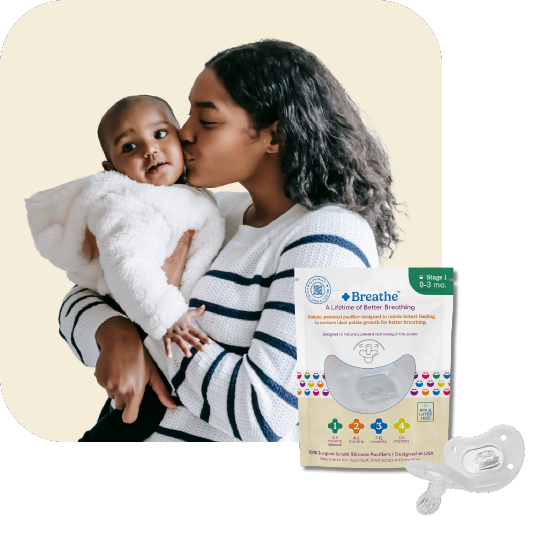
Why The Breathe® Baby Pacifier Is Different
Not every baby can be breastfed, but now every baby can still receive the physiological benefits of breastfeeding that encourage optimal palate and airway growth.
Our pacifier’s unique geometry redirects tongue pressure laterally—similar to breastfeeding—to guide natural jaw and airway development. This early support can help reduce the likelihood of breathing problems, sleep disturbances, and orthodontic treatments later in life.
Study: Breastfeeding Stimulates the Development of the Orofacial Complex
Key Points
- The method and technique of feeding a young child affects the shape of the bones and soft tissues that make up the face and jaw.
- Breastfeeding stimulates the muscles and growth of the jaw bones.
- Breastfeeding is the recommended method of feeding in the first six months of life. It is encouraged to continue natural feeding in later months…